Ever wondered why $100 USD gives you different amounts of Euros, Yen, or British Pounds on different days? That’s because currency exchange rates are constantly changing. This article explains in simple terms how these rates are calculated, what affects them, and how you can calculate conversions yourself.
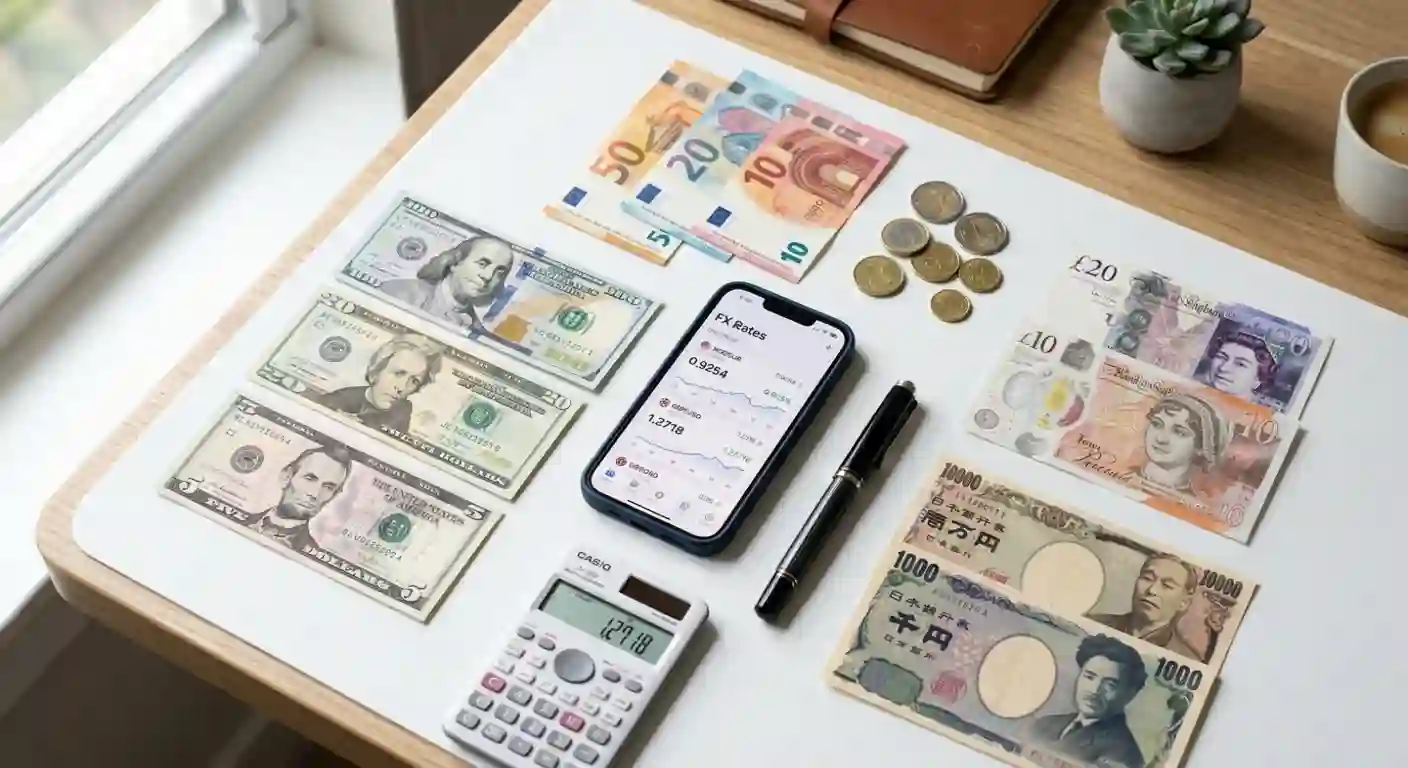
What Is an Exchange Rate?
An exchange rate is simply the value of one currency compared to another. It tells you how much of Currency B you can get for one unit of Currency A.
For example:
If USD/EUR = 0.92
→ $1 USD buys €0.92 Euros

If GBP/USD = 1.27
→ £1 British Pound buys $1.27 USD
Exchange rates are always expressed as currency pairs.
The Basic Calculation Formula
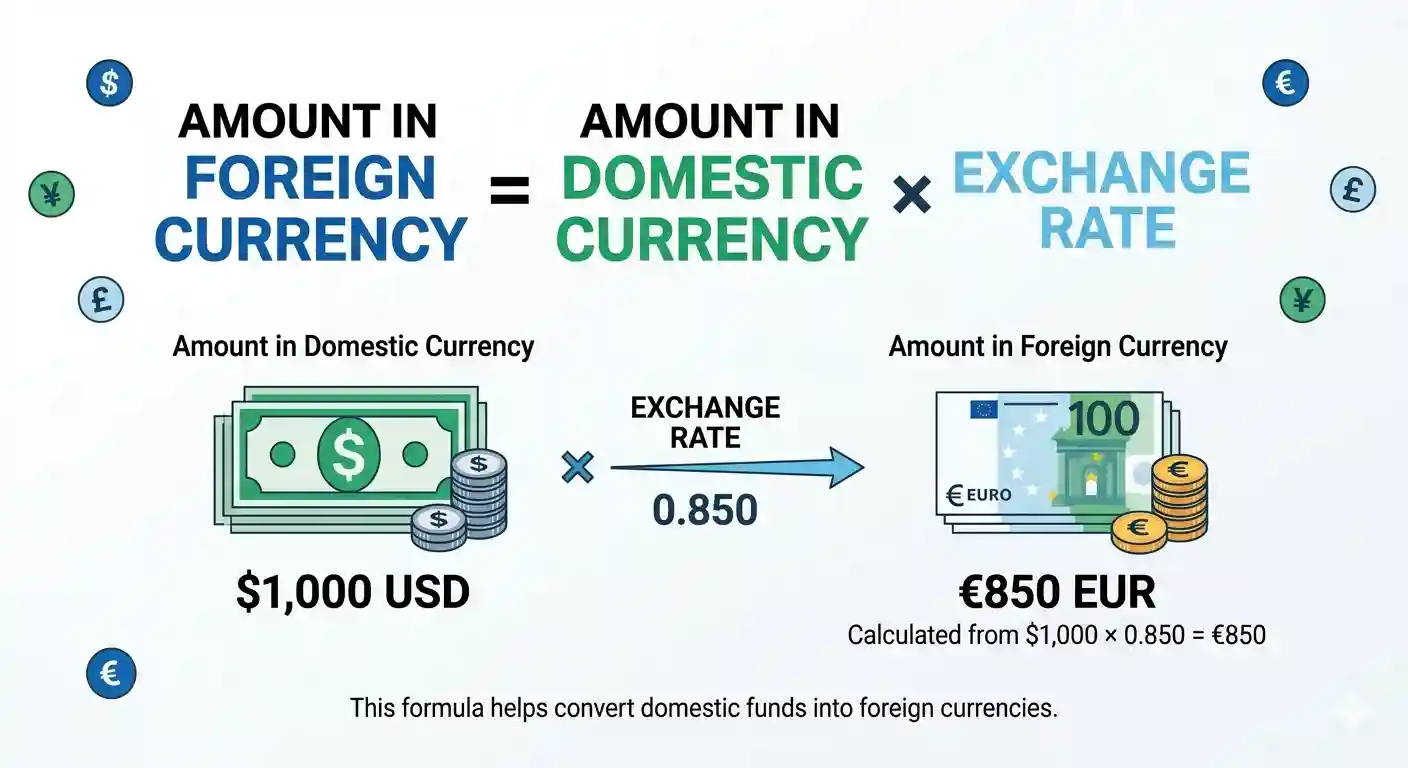
The formula for calculating how much currency you’ll get is straightforward:
Amount in Foreign Currency
=
Amount in Domestic Currency × Exchange Rate
Real-World Example
Let’s say you want to convert $1,000 USD to Euros and the exchange rate is 1 USD = 0.85 EUR:
1,000 USD × 0.85 EUR/USD = 850 EUR
To go the opposite direction (from foreign currency back to your domestic currency), you divide by the exchange rate:
Amount in Domestic Currency
=
Amount in Foreign Currency ÷ Exchange Rate
Two Types of Exchange Rate Systems
Countries use different systems to determine their exchange rates:
| Type | How It Works | Example |
|---|---|---|
| Fixed Exchange Rate | The government sets a specific value, often tied to gold or another currency | China’s yuan (historically tied to USD) |
| Floating Exchange Rate | Determined by supply and demand in the global market | USD, EUR, GBP, JPY |
| Managed Floating | Mostly market-driven but government/central bank can intervene | Most modern currencies today |
Current international exchange rates use a managed floating system, meaning currencies are affected by both market forces and government/central bank actions.
What Factors Influence Exchange Rates?
Exchange rates constantly move based on these key factors:
1. Supply and Demand
When more people want a currency, its value goes up. When fewer want it, value goes down.
2. Economic Performance
Strong GDP growth and exports usually increase currency value. High unemployment and imports can weaken it.
3. Interest Rates
Higher interest rates attract investors seeking better returns.
4. Inflation
Low inflation strengthens currency while high inflation weakens it.
5. Political Stability
Stable governments attract investment and strengthen currency value.
6. Market Sentiment
Investor expectations and rumors can rapidly affect exchange rates.

Economic Performance and Currency Value
| Factor | Impact on Currency |
|---|---|
| Strong GDP growth | Currency value increases |
| High unemployment | Currency value decreases |
| Strong exports | Currency value increases |
| High imports | Currency value decreases |
How the Numbers Actually Work: Base vs. Quote Currency
Understanding currency pairs is crucial:
| Term | Definition | Example in EUR/USD = 1.08 |
|---|---|---|
| Base Currency | The first currency (always 1 unit) | EUR (1 Euro) |
| Quote Currency | The second currency (how much you get) | USD ($1.08) |
- From the base currency → Multiply by the exchange rate
- To the base currency → Divide by the exchange rate
Practical Examples
| Conversion | Operation | Calculation | Result |
|---|---|---|---|
| $1,000 USD → EUR | Multiply | 1,000 × 0.92 | €920 |
| €500 → USD | Divide | 500 ÷ 0.92 | $543.48 |
| £200 → USD | Multiply | 200 × 1.27 | $254 |
| $300 → GBP | Divide | 300 ÷ 1.27 | £236.22 |
Why You Don’t Get the “News Rate”
The rate you see on TV or Google is the interbank rate (also called spot rate)—the wholesale rate banks use with each other.
When you exchange money as a consumer, you get the retail rate, which includes:
| Term | Definition |
|---|---|
| Spread | Difference between buy and sell rates (covers costs and profit) |
| Sell Rate | Rate when the provider sells you foreign currency |
| Buy Rate | Rate when the provider buys foreign currency from you |
Interbank Rate:
1 USD = 0.90 EUR

Bank sells EUR:
1 USD = 0.88 EUR

Bank buys EUR:
1 USD = 0.92 EUR

Spread:
0.04 EUR per USD
Cross Rates: When There’s No Direct Pair
Sometimes you need to convert between two currencies that don’t have a direct exchange rate. You use the US dollar as an intermediary.
Example: Converting EUR to JPY
EUR/USD = 1.08
USD/JPY = 149.50

EUR/JPY
=
1.08 × 149.50
=
161.46
So 1 Euro = ¥161.46 Japanese Yen.
Quick Reference: Major Currency Pairs
| Currency Pair | Common Name | What It Means |
|---|---|---|
| EUR/USD | “Euro” | How many USD for 1 EUR |
| GBP/USD | “Cable” | How many USD for 1 GBP |
| USD/JPY | “Ninja” | How many JPY for 1 USD |
| USD/CHF | “Swissie” | How many CHF for 1 USD |
| AUD/USD | “Aussie” | How many USD for 1 AUD |
| USD/CAD | “Loonie” | How many CAD for 1 USD |
Common Mistakes to Avoid
- Confusing buy/sell rates: Remember, the “sell rate” is when the bank sells you foreign currency.
- Forgetting the spread: The rate you see isn’t what you’ll actually get.
- Mixing up multiply/divide: Use the base currency rule correctly.
- Ignoring fees: Many providers charge additional transaction fees beyond the spread.
Frequently Asked Questions
Exchange rates change constantly, every second, while global forex markets are open (24 hours a day, 5 days a week).
For floating currencies, market supply and demand set rates. For fixed currencies, governments or central banks set them. Most modern currencies use a managed floating system where both market forces and central banks play a role.
Each bank adds its own spread (profit margin) and may charge different fees. The interbank rate is the same for everyone, but retail rates vary by provider.
Yes. You only need:
- The current exchange rate
- The amount you want to convert
- Multiply if converting from base currency, or divide if converting to base currency
Spot rate: Current exchange rate for immediate delivery.
Forward rate: Agreed-upon rate for a future date, commonly used by businesses to reduce risk.
- Economic data releases
- Central bank interest rate decisions
- Political events and elections
- Trade activity and balance of payments
- Market speculation and sentiment
The US Dollar (USD) is the most traded currency worldwide, appearing in about 88% of all forex transactions. It is also the primary reserve currency for many countries.
- Compare multiple providers
- Avoid airport exchange kiosks
- Use no-foreign-transaction-fee cards
- Consider specialized transfer services