
Understanding Currency Symbols & ISO Currency Codes
Every country uses its own currency, and many groups of countries share one currency. To avoid confusion in international trade, banking, travel, and online shopping, the world relies on currency symbols and ISO currency codes. Together, they help people and computer systems identify money accurately.
💲 What Is a Currency Symbol?
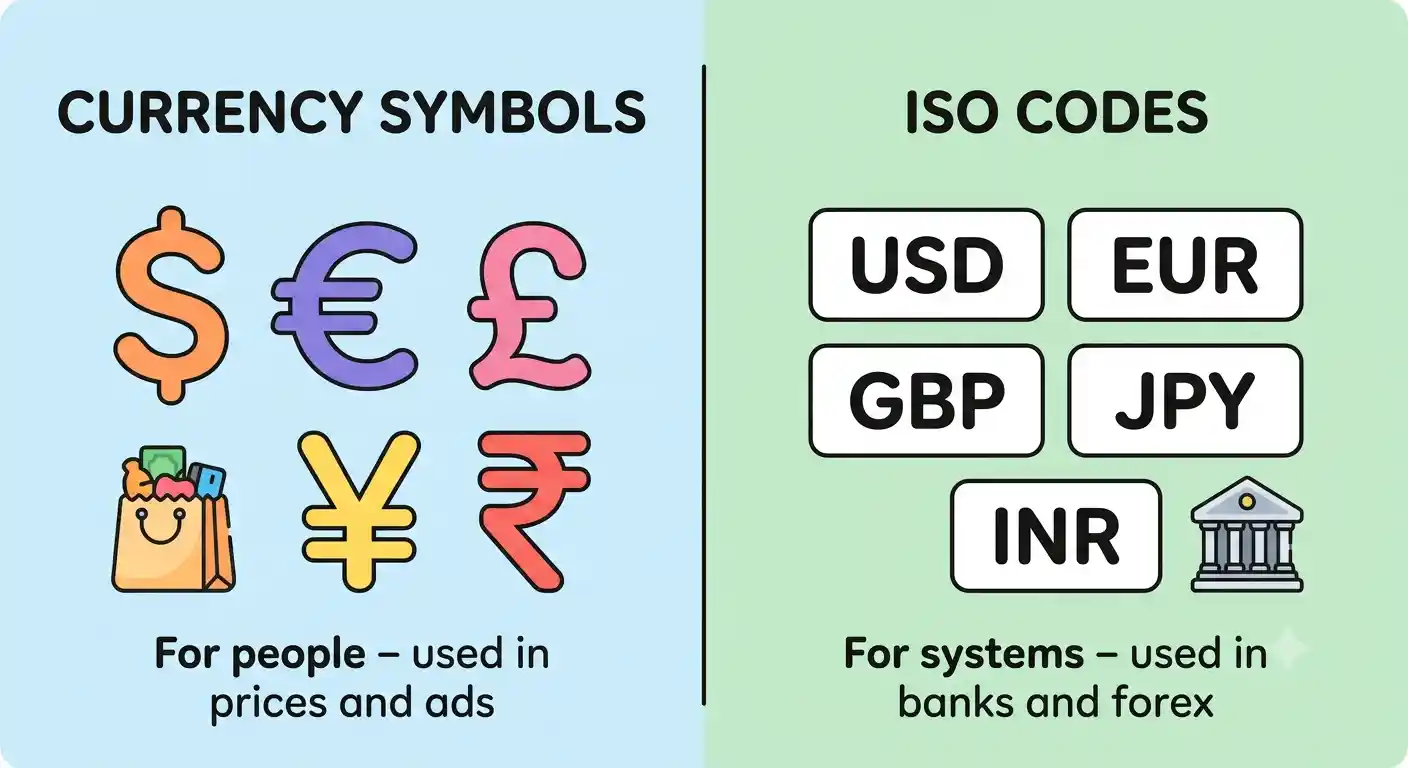
A currency symbol is a short graphic sign used to represent money. It makes prices easy to read and helps save space in advertisements, invoices, and receipts.
- $ — US Dollar
- € — Euro
- £ — British Pound
- ¥ — Japanese Yen
🌍 What Is an ISO Currency Code?
An ISO currency code is a unique three-letter code defined by the ISO 4217 standard. These codes are used globally in banking, finance, online shopping, and foreign exchange.
- USD
- EUR
- GBP
- JPY
- INR
How ISO Currency Codes Are Built
ISO currency codes follow a simple and logical naming system. Usually, the first two letters represent the country code, while the third letter represents the currency name.
First two letters come from the ISO country code.
The third letter usually represents the currency.
Examples: USD, GBP, EUR, JPY.
Numeric ISO Currency Codes
ISO 4217 also assigns every currency a unique three-digit numeric code. These are especially useful in banking software, payment gateways, and countries that do not use the Latin alphabet.
- 840 → USD
- 978 → EUR
- 392 → JPY
- 124 → CAD
Currency Symbols vs ISO Currency Codes
| Feature | Currency Symbol | ISO Currency Code |
|---|---|---|
| Type | Graphic sign ( $, €, £ ) | Three-letter code (USD, EUR) |
| Primary Use | Prices and advertisements | Banking and international payments |
| Standard | No universal standard | ISO 4217 |
| Length | 1–2 characters | Always 3 letters |
| Example | $10 | USD 10.00 |
Common Currency Symbols and Codes
Code: USD
Code: EUR
Code: GBP
Code: JPY
Code: INR
Code: AUD
Code: CAD
Code: CNY
Important Note
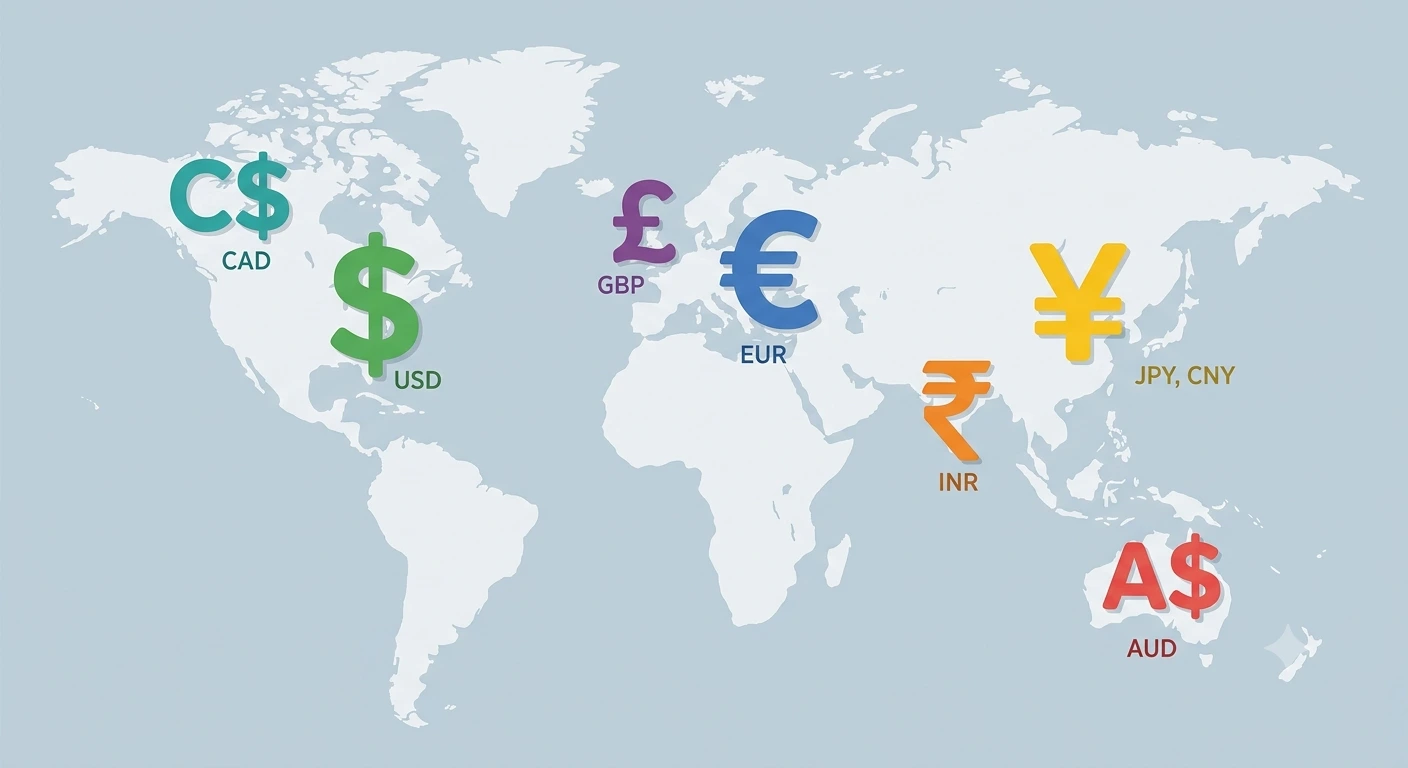
Some currencies share the same symbol. For example, the “$” symbol is used for the US Dollar, Australian Dollar, Canadian Dollar, and several other currencies. ISO currency codes remove this ambiguity by giving every currency its own unique identifier.
Why We Need Both Symbols and ISO Codes
Easy for People
Symbols make prices simple to read in shops, advertisements, receipts, and invoices.
Reliable for Systems
ISO codes are essential for banking systems, databases, APIs, payment processors, and accounting software.
Avoid Confusion
Using “USD” instead of “$” makes it clear which dollar is being referenced, reducing mistakes in international transactions.
Supports Global Trade
Businesses, governments, and financial institutions depend on ISO currency codes to process accurate international payments.
Frequently Asked Questions (FAQs)
Find answers to common questions about ISO currency codes, currency symbols, and how they are used in international finance and everyday transactions.
The official standard is called ISO 4217. It defines three-letter alphabetic currency codes (such as USD and EUR) together with three-digit numeric currency codes used worldwide.
The International Organization for Standardization (ISO) maintains the ISO 4217 standard. A maintenance agency updates the list whenever currencies are introduced, renamed, or withdrawn.
There are over 180 active currency codes, along with special codes such as XAU (gold) and XAG (silver). Including historic and special-purpose codes, the total is close to 300.
No. Some symbols like $ and ¥ are shared by multiple currencies, while others such as €, £, and ₹ are unique. Some currencies do not have an official symbol.
Almost all countries and international financial systems use ISO currency codes. They are considered the global standard for banking, accounting, and international trade.
A currency symbol is a graphical sign such as $, €, or £. A currency code is a three-letter ISO code like USD, EUR, or GBP. Symbols are mainly used for people, while codes are used by financial systems and international businesses.
Yes. For example, the dollar symbol ($) represents several currencies including USD, CAD, AUD, NZD, and others. ISO currency codes help remove this ambiguity.
These are special ISO 4217 codes:
- XAU – Gold
- XAG – Silver
- XDR – Special Drawing Rights (IMF)
They are commonly used in commodity trading and international financial markets.
Use currency symbols for everyday prices (for example, $20 or €15) and ISO codes for formal or international documents (USD 20.00 or EUR 15.00). When a symbol is shared by multiple currencies, use prefixes such as US$, C$, or A$ for clarity.